Phipps Stories
Up Next: Tropical Forest Australia
Every three years, the Tropical Forest exhibit is transformed as it gains inspiration from a new location. Planning for the next exhibit begins almost as soon as the current display is installed. A small group of five Phipps employees are tasked with scoring different aspects of rain forests around the globe based on a rubric. They consider topics such as biodiversity, threats to the given forest and the appeal the location may have to Phipps guests. Australia has been considered for many years and this year they decided it was time to move forward and create the Daintree Rainforest exhibit.
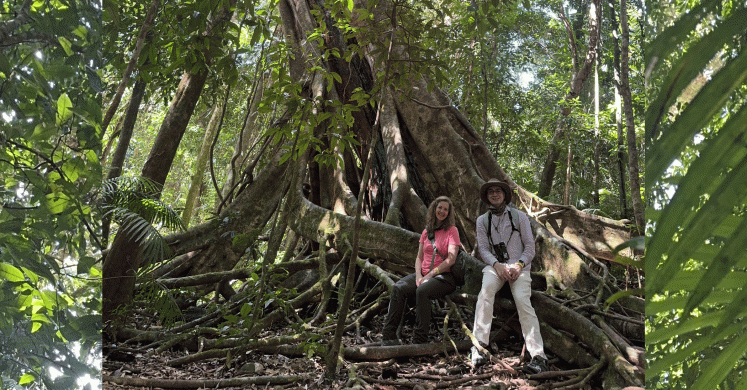
Jordyn Melino, Associate Director of Exhibits, and Giovanny Giraldo, Horticulture Collections Manager, traveled to the other side of the world to visit the Daintree Rainforest located in Queensland, Australia. The Daintree Rainforest is unique as it is the largest continuous swath of rainforest in Australia and is older than the Amazon Rainforest. This ancient rainforest is also one of the only places on Earth where two UNESCO World Heritage sites touch side-by-side; the Daintree rainforest meets the Great Barrier Reef. These two ecosystems share very important functions. The forest collects and cleans the water, carrying nutrients from the soil through the mangroves with the rising and falling tide. This nutrient exchange is beneficial to both the Great Barrier Reef and the forest.
The region has been greatly affected by global warming. In 2023, Cyclone Jasper hit the northeastern coastline with unprecedented rain. Much of the Daintree was underwater and many of the parks’ inhabitants’ homes were destroyed along with much of the forest. Due to the increased water temperature and moisture from global warming, Jasper gained significant power. Giovanny explained how native inhabitants use the local flora and fauna as a calendar, synchronizing hunting and food gathering by what is blooming, emerging or dying back. Along with humans, the climate shift affects insects such as bees that emerge before the flowers bloom and are having difficulty finding enough food. Rising temperatures have altered this natural calendar leading to whole ecosystem effects.

Jordyn and Giovanny arranged to meet with many potential partners while visiting Australia, making connections with educational institutions and local indigenous tribes to gain a better understanding the land and inhabitants of the region. James Cook University, an educational partner, operates a canopy crane, an industrial crane that allows scientists to observe the canopy of the forest. The crane stands 47 meters or 154 feet tall with a basket that dangles over the canopy. They were able to see the Daintree forest all the way to the coast where the mangroves meet the sea. While dangling over the canopy, they encountered a nest of Greentree Ants (Oecophylla smaragdina). These ants build nests by folding living leaves and stitching them together with larval silk. Their guide shook the nest and when the ants emerged, they plucked a few and ate them! Jordyn said they were quite tasty, having a lemony flavor.
They visited the Mossman Gorge, where the Kuku Yalanji people have developed a thriving eco-tourism culture. The Mossman Gorge Cultural Center employs a 90% indigenous workforce, offering many educational programs that focus on protecting the forest and sharing indigenous stories and beliefs. In 2021, the ownership of the land was returned to the traditional indigenous stewards in a historic agreement with the Australian government. Jordyn and Giovanny were able to connect with and indigenous weaver, Shanelle Lenoy. They had a private two-hour basket weaving class to learn traditional techniques. While they were weaving, Shanelle shared stories of growing up in the Mossman area and the plight of the lost generation of indigenous people. They were honored and deeply touched to learn about this piece of recent history from someone who had lived through it.

Giovanny was excited by the ancient plants that are native to the Daintree. He was thrilled to see many King Ferns. These ferns have a lineage that is 200- 300 million years old acting as a living relic of the time of the dinosaurs. These massive ferns can grow fronds that reach 25 feet in length! The team also saw a cassowary, a giant flightless bird that is native to the rainforest. Cassowaries can grow to be six feet tall! They are essential to the health of the forest, primarily eating fruit that is poison to other animals and spreading the seeds through the forest via their dropping.
Jordyn and Giovanny are excited to share all that they learned while visiting the Daintree Rainforest. The new exhibit is still a couple of years away, but learning about the extensive planning process can be just as exciting!